We all know we need to move our bodies to feel fit and healthy. With 70 years of comprehensive research into the benefits of movement, we’ve got this message loud and clear. But that’s just part of the solution to feeling good. Living through lockdown life in 2020/21 may have alerted you to this too – the damaging effects of sedentary life and how we sit – at our desks, scrolling on our phones, in the car or even on our bicycles.
The average person in the UK sits for 9.5 hours a day, and in the US it’s close to 10 hours. By contrast, the average person spends 2 hours a week being physically active – that’s 2 hours compared with 70 hours sitting. We sit on average three hours more a day than we did just two decades ago.
But it’s not just sedentary life that’s bad for us, it’s how you sit that matters too.
The research into the consequences of too much sitting have lead the media to claim for good reason that ‘sitting is the new smoking’. We’ve learnt first-hand through lockdown that a sedentary lifestyle is a sure fire recipe for fatigue and muscular tension, which put the kybosh on zest, confidence, and a buoyant mood.
What have we learnt?
The research roundup of sitting poorly in chairs:
• Sitting in chairs requires less muscle engagement, thinning our bones, weakening our muscles and reducing our muscles mass, which then has a knock on effect of lowering metabolism and interfering with blood sugar regulation.
• Sitting reduces circulation, diminishing the availability of nutrients and oxygen, and impeding the removal of waste products, leading to swelling, stiffness and pain in joints and muscles.
• Sitting harms cardiovascular health by elevating triglycerides and altering the blood vessel functioning. Blood vessel walls become stiffer making them more prone to coronary heart disease.
• Sitting reduces our digestive health by diminishing our capacity for diaphragmatic breathing which leads to constipation and bloating. The diaphragm acts as bellows, providing a massaging action, moving waste towards the bowels.
• Inactivity leads to immune dysfunction. We need movement to help mechanically pump lymph around the body. If we don’t move, the lymph doesn’t move, leading to fatigue and sluggishness.
• Sitting still, coupled with slouching increases negative mood, stress and depressive symptoms potentially due to the inflammation caused by immobility and limited capacity for diaphragmatic breathing.
• Add to this tech stress and the pressure of poor posture leads to a raft of aches, pains, tension and injuries specifically for the spine, neck, shoulders, wrists and hands, low levels of chronic tension that disrupt quality sleep, shallow breathing, eye strain, headaches, the forward head posture created by screens reducing blood supply to the brain, leading to fatigue and stress, and the diminished range of motion for the head to turn and scope the scene around us , potentially making us feel more vulnerable to threat and anxious as a result.
What do we need to do to protect our health, energy and longevity?
1. Improve our posture, while sitting, standing and moving.
2. Optimise our environment to support us in sitting well.
3. Break up sedentary periods every 30 minutes with micro moments of movement.
4. We also need to undo the strain and tension caused by sitting. We achieve this with
• Stretching exercises
• Breathing practices
• Restorative practices to revive and release stress
• Practices to boost circulation and digestion
Posture 101: 3 steps to improving your posture:
1. Insight: Awareness of how you are holding your body and knowledge of what healthy posture is.
2. Strength: Developing the muscles responsible for holding you upright.
3. Flexibility: Increasing suppleness so we can sit, stand and move with freedom.
What is good posture?
Rather than explain posture in complex anatomical terms, I want to bring posture to life by describing how it feels, beginning with standing posture:
Starting from the ground up, place your feet hip width apart with your toes pointing forwards and your weight spread evenly between your right and left foot. Lift up all your toes, fan them out and extend them back down lightly. Your toes help you balance rather than bearing weight. Distribute your weight evenly between the inner and outer edges of your feet and between the balls and heels of your feet. Keep a little softness in your knees so the joint is not locked, allowing the muscles in the front of your thighs to gently hug your thigh bones.
Imagine your pelvis is a bowl – healthy posture keeps it level so there is a feeling of containment in your lower abdomen. If your tailbone sticks out behind you, the bowl tips forwards. If you tuck your tailbone under, the bowl spills backwards. A subtle lift through the pit of the abdomen, created by drawing your navel towards your spine, keeps the bowl of your pelvis level.
Feel your whole ribcage lift evenly, front and back, both sides, away from your hips. Slide your shoulder blades flat against your back, broadening your chest and bringing your arms to hang with your middle finger aligned with the midline of your outer thigh. Elongate your neck, lower your jaw parallel to the floor and snake the crown of your head skywards. Soft gaze forwards.
Now imagine there is a pane of glass in front of you and behind you so you can’t arch your back like a soldier or round your spine in a smart phone slump, you can only send roots down through your legs and feet, elevate your ribcage and blossom the crown of your head upwards. Feel this equal opposite grounding and ascension, bringing balance and symmetry to your body, lifting your mood and energy, creating freedom to breathe, and space and support for the healthy functioning of your internal organs. In this ‘neutral spine’ position we maintain the three natural curve of the spine – at the lower back, mid back and neck, stacking your head above your shoulders and the top of your shoulders above your hips.
Introducing Mountain Breaths, your daily morning routine to improve your posture
To begin your day with zest, presence and good posture, welcome to Mountain Breaths. This will take as little as one minute but its impact can last your whole day long.
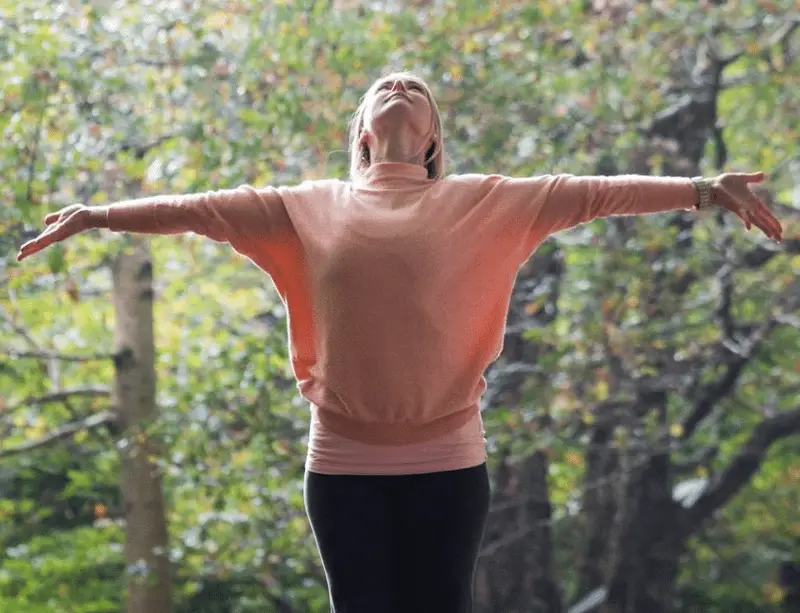
Stand tall with your feet hip width apart, arms down by your sides and your gaze forwards. Notice how it feels to be standing, the sensation of your feet against the floor, the strength of your legs and core, the elongation of your spine and the buoyancy of your head. Now begin moving with your breath, where you will breathe in and out through your nose unless you are congested. On your next inhalation slowly raise your arms out to your sides and up above your head, looking up to your hands, palms touching when you finish breathing in. Allow a tiny pause here and then enjoy a long, slow exhalation, gazing forwards again, palms reaching your outer thighs when you are ready to finish breathing out. Repeat this mindful movement in time with your breath 5 to 10 times. Feel how this sequence helps you lift more effortlessly into good posture and not only are you waking up to the day but you are waking up your mindfulness muscles, helping you become more aware of your body and your breath.
In embarking on this morning routine you are building your ability to notice your body, patterns of tension, time spent sitting, your posture and your breath. To further bring this wakeful quality to your whole day, identify salient opportunities to check in with yourself. It could be while you are brushing your teeth, during your shower, when you first sit down at your desk, while stopped at a red light, during loo breaks, while the is kettle boiling, sending emails, checking social media, or when you receive a message notification. If you need to at first, set a timer to check in and take any necessary restorative action. See what grows from your new found awareness.
About the Author
Suzy is a mother of two, an author, Chartered Psychologist and Coach. She specialises in self-care, helping people manage their stress, emotions, and energetic bank balance. It was her life experience of motherhood colliding with the terminal illness of her father that sparked her passion for self-care which she now teaches to her clients, young and old, to cope during periods of stress, loss and change and to boost their resilience in the face of future challenges. Suzy is on the editorial board for Motherdom Magazine, the Psychology Expert for wellbeing brand Neom Organics and is a founding member of the ‘Nourish’ app. She figure-skated her way through her childhood, growing up on the Northern Beaches of Sydney, and now makes her home in the hills of Hertfordshire, UK. Her first book ‘The Self-Care Revolution’ published by Aster came out in 2017, ‘Stand Tall Like a Mountain: Mindfulness & Self-Care for Children and Parents‘ and ‘The Little Book of Self-Care’ came out in 2019. ‘Self-Care for Tough Times’ and her first children’s book ‘This Book Will (Help) Make You Happy’ were published in 2021. Her first journal And Breathe is hot off the press and Sit to Get Fit is available now.